The Evolution of Baseball

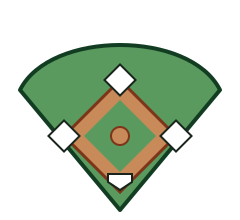
Baseball is a bat-and-ball game played between two teams of nine players. The teams take turns batting and fielding. A batter tries to hit a ball thrown by the opposing pitcher and then run around four bases to score a run. The team with more runs at the end of the game wins.
A game is divided into innings. In each inning both teams bat once, and a team's turn ends when the fielding side gets three outs. This guide follows how the sport grew from simple early games into a professional game played around the world.
Origins

Older bat-and-ball games
Baseball grew out of older bat-and-ball games played in Britain and North America, such as rounders. No single person invented it, and the exact path from those games to baseball is not fully known.
A popular myth
A widely repeated story credits Abner Doubleday with inventing baseball in 1839 in Cooperstown, New York. Historians do not accept this story, and it is better understood as a legend than as history.
Written rules in New York
In 1845 the Knickerbocker Base Ball Club of New York wrote down a set of rules. They were not the first rules, but they helped shape the game and show how organised baseball was taking form in the 1840s.
How the game changed
Becoming professional
The Cincinnati Red Stockings of 1869 are widely regarded as the first openly all-professional team. The National League was founded in 1876, and the American League followed as a major league in 1901. In 1903 the champions of the two leagues met in the first modern World Series.
Changes to the game itself
Early rules were very different from today's. Over the decades the distance between the pitcher and the batter was changed, and rules on how pitches may be thrown were revised. In the 1920s the game saw more home runs, led by Babe Ruth, and that changed how teams played.
Opening the doors
For decades Black players were kept out of the major leagues and played in the Negro leagues. In 1947 Jackie Robinson played for the Brooklyn Dodgers and broke the major leagues' colour barrier.
Modern rule changes
The American League adopted the designated hitter in 1973. Major League Baseball expanded its use of instant replay review in 2014, and a pitch clock arrived in 2023 to speed up play.
Why people love it
Baseball is a game of many small contests: pitcher against batter, runner against fielder. A single play can change a game, and the lack of a clock means a team that is behind is never out of it until the final out.
The slower pace gives fans time to follow strategy, talk with the people next to them and enjoy the setting. The game also keeps careful records, so fans can compare players and seasons across generations. For many families, going to a game and passing the sport from one generation to the next is a tradition.
Baseball today
Baseball is played professionally in many countries. Major League Baseball in the United States and Canada draws players from across the world, and leagues such as Nippon Professional Baseball in Japan and the KBO League in South Korea have large followings. The sport is also strong in Cuba, the Dominican Republic, Mexico and Venezuela.
Baseball appeared at the Tokyo Olympic Games, held in 2021. Analysis of data now plays a large role in how teams build rosters and choose strategy.
Quick facts
- Players per team on the field
- 9
- Innings in a standard game
- 9
- Outs per team in an inning
- 3
- Strikes for a strikeout
- 3
- Balls for a walk
- 4
- Distance between bases
- 90 feet (about 27.4 metres) in professional baseball
- Distance from pitching rubber to home plate
- 60 feet 6 inches (about 18.4 metres)
- Games in a regular Major League Baseball season
- 162 per team